
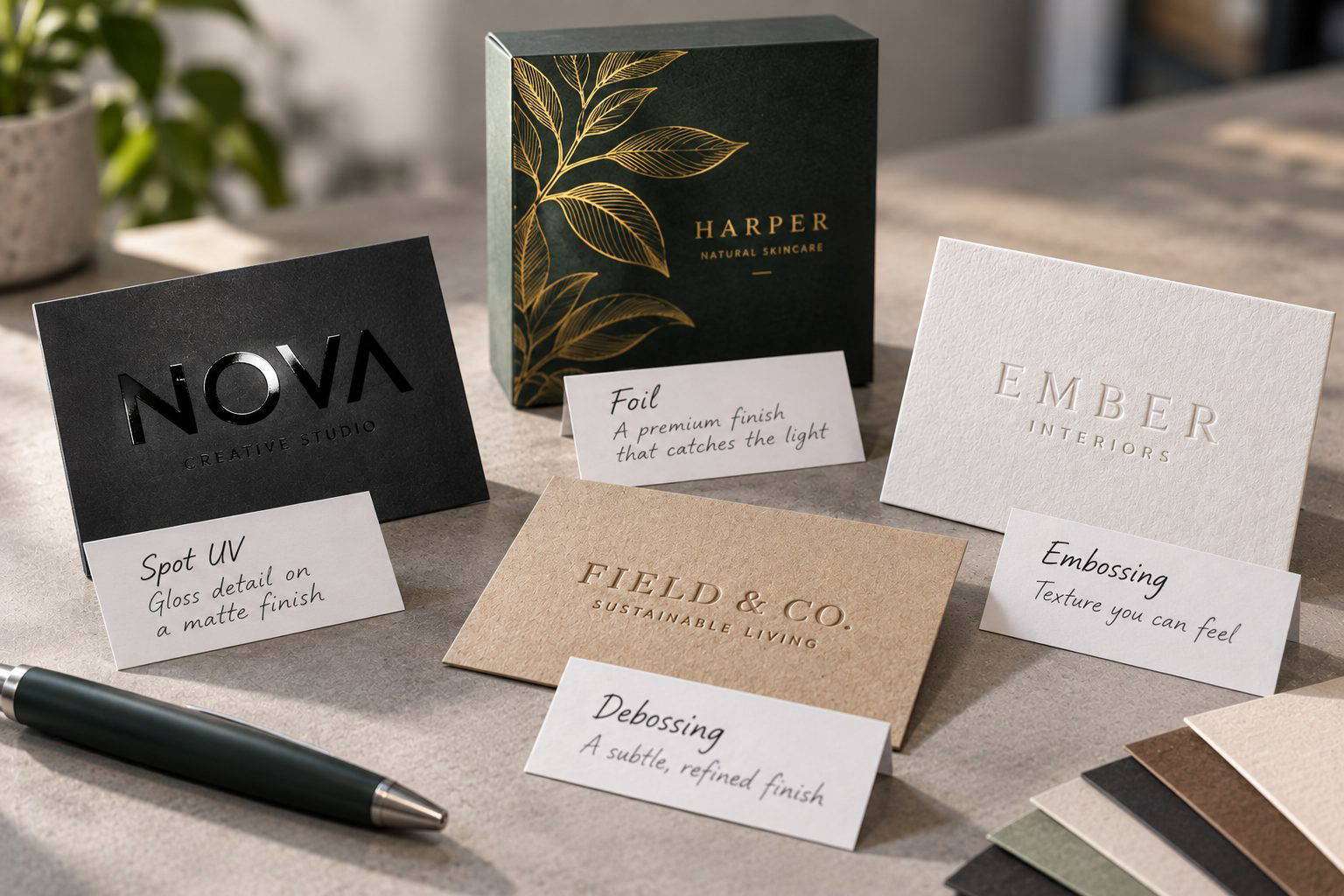
Why premium finishes matter on small print
Business cards and packaging often get seconds to do their job. A premium finish adds contrast you can feel and see, even when the design is simple. The key is choosing an effect that suits the stock, the artwork, and how the piece will be handled. A card that lives in a wallet needs a different approach from a swing tag, mailer box, or product sleeve that will be stacked, shipped, and scuffed.
In a print shop, the best results come from planning finishes at the artwork stage. Build files in CMYK for print, keep images at 300 dpi, and only use RGB if you are supplying brand assets that will be converted for press. If colour accuracy matters, ask for a printed proof rather than relying on a backlit screen.
Spot UV: sharp shine on matte stock
Spot UV is a clear, high-gloss coating applied in specific areas. It works brilliantly on matte laminated business cards and packaging sleeves because the shine has something to play against. Think a black or deep CMYK navy background with a glossy logo, or a soft-touch card with glossy geometric lines that catch the light.
When Spot UV works best
- Matte or soft-touch lamination underneath for maximum contrast
- Bold shapes and thicker typography that will hold crisp edges
- Packaging panels that are handled lightly, such as cosmetic sleeves
- Designs where you want highlight detail without adding thickness
Practical tip: avoid tiny text in Spot UV. On press it can fill in and lose definition. Also leave a small safety gap between UV and any tight creases or folds on packaging to reduce cracking risk.
Foil: instant premium, best used with restraint
Foil stamping uses heat and pressure to transfer metallic or pigmented foil. It reads as luxury fast, so it suits hospitality cards, real estate folders, and gift packaging. In the shop, we often see foil used well on minimal designs: a small foil wordmark centred on a thick card, or a single foil pattern band on a box lid.
Foil is less forgiving than ink. Keep foil artwork as vector, avoid gradients, and use solid shapes. If your background is a rich CMYK build, remember foil will sit on top, so test readability and avoid overly busy textures beneath.
Embossing: texture you can feel
Embossing raises the paper, creating a sculpted impression. It is ideal for uncoated stocks and heavier boards where the fibres can take a clean lift. A classic example is a letterpressed style card without ink, using a blind emboss for a monogram. On packaging, embossing works well for crests, seals, and tactile brand marks on rigid sleeves.
Allow for the squeeze. Fine lines and tiny counters can close up. If you want detail, simplify the mark and increase stroke weights. Also consider grain direction on folded packaging panels, as it can affect how cleanly the board forms.
Debossing: understated depth for premium brands
Debossing presses the design into the stock, leaving a recessed impression. It is subtle, smart, and pairs nicely with uncoated business cards, kraft packaging, and minimalist branding. In practice, debossing is often chosen for brands that want confidence without shine, such as architects, boutique food makers, and wellness products.
Debossing can be combined with foil for a recessed metallic look, but keep the artwork simple and use sufficient spacing between elements so the die does not distort fine details.
Choosing the right finish for your job
If you want high contrast and modern impact, Spot UV over matte laminate is a reliable choice. If you need a premium signal at first glance, foil is hard to beat. If you want tactile branding that feels crafted, embossing and debossing are the tools. Match the finish to how the piece will be used, then build artwork that gives the process room to shine.
Need help with Spot UV, Foil, Embossing or Debossing?
If you are planning a similar print job, contact Melbourne Print for practical advice based on your artwork, quantity, finish, and deadline. You can also email our team or check our print-ready artwork guide before sending your files.