
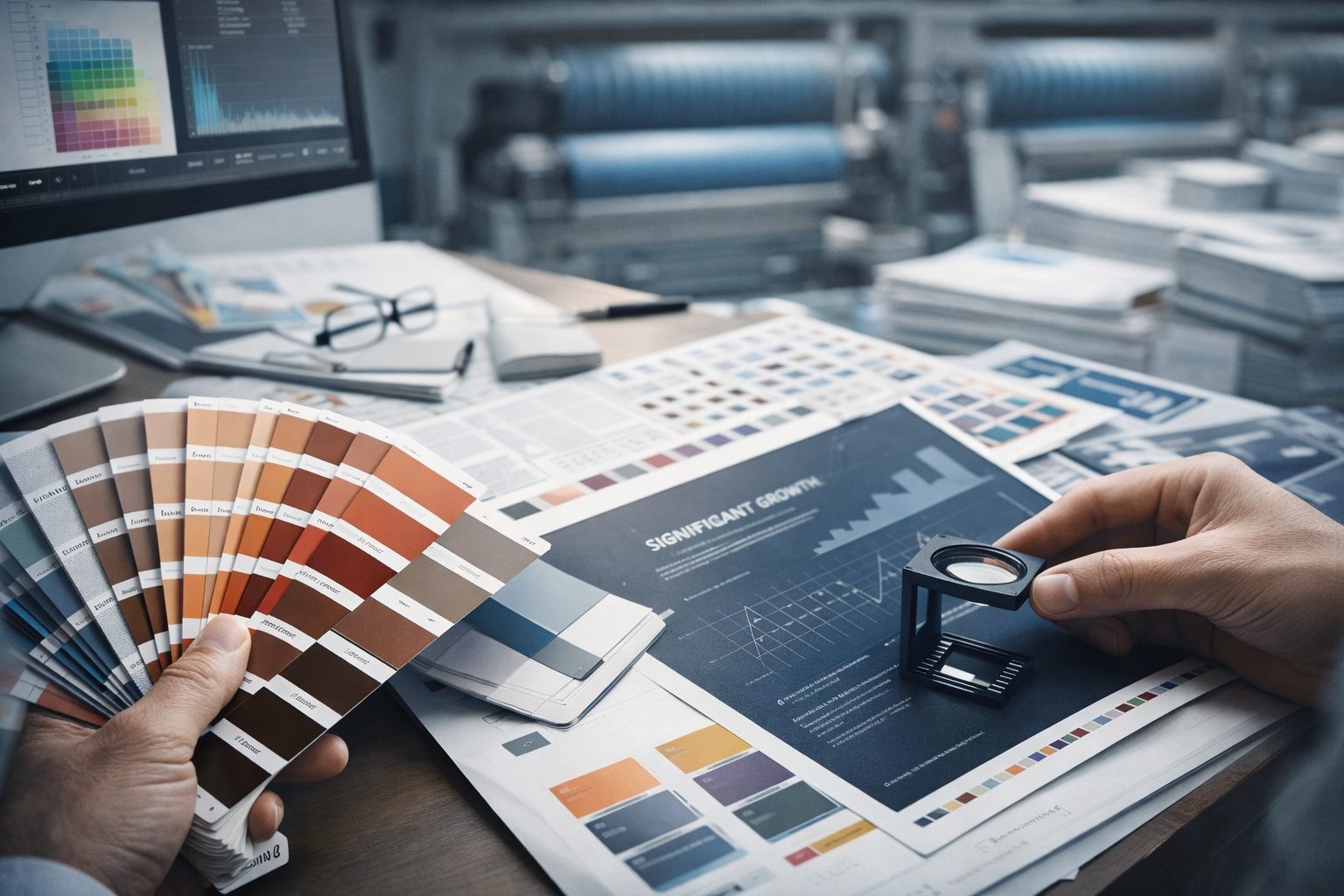
Most people only see print at the moment it arrives.
A box on reception. A stack of brochures on a table. A set of invites laid out, finally, exactly as they looked in your head.
If it goes well, it looks effortless.
If it goes badly, it is suddenly very visible. Colours are off. Finishes do not feel right. A fold is out. A deadline is missed. And you are left trying to explain why something that seemed simple has become complicated.
That is the gap “first-time-right” is meant to close.
But first-time-right is not a product feature. It is not a quick tick box, or a line on a quote.
It is the behind-the-scenes work that prevents avoidable errors from ever reaching press.
Here is what it really takes.
1) A proper brief, not just a file and a quantity
A first-time-right job begins before anything is printed.
It starts with questions that protect outcomes:
- What is this for, and what does success look like?
- Where will it be used, and under what lighting or conditions?
- What matters most: colour accuracy, tactile feel, longevity, speed, or all three?
- Is this going to an event, an investor meeting, a retail shelf, or a press pack?
- Who needs to approve, and what do they worry about?
A PDF can tell us what you want to print. It cannot always tell us what you need it to do.
Behind the scenes, the difference matters. Because the way something performs in the real world should shape the choices we make in production.
2) File checking that is human, not just automated
Pre-flight software is useful. It catches missing fonts, low resolution images, and obvious setup issues.
But first-time-right needs a human eye too.
Because the problems that cause reprints are often subtle:
- A rich black that will print muddy on an uncoated stock
- A fine reverse line that will fill in once ink hits paper
- A logo sitting too close to a fold, trim, or perforation
- A colour build that looks fine on screen but will not hold consistently on press
- An overprint setting that will vanish an element entirely
This is the point where calm guidance matters most. Not “your files are wrong”, but “this is what will happen if we print it like this, here are the options”.
Exceptional brands do not want a lecture. They want certainty.
3) Colour management that respects your brand, not just the machine
Colour is where many jobs drift.
And it happens for understandable reasons. Screens vary. Lighting varies. Paper stocks vary. Even two “white” papers can make the same ink look different.
Behind the scenes, first-time-right colour requires decisions, not guesses:
- Are we matching a Pantone reference, an existing printed piece, or a visual expectation?
- Is this a brand-critical colour where “close enough” is not acceptable?
- Does the job need a contract proof, or is a calibrated digital proof sufficient?
- Are we printing on uncoated stock that will soften the colour?
- Do we need to adjust artwork to achieve the right result on the chosen stock?
This is where a good print partner will slow down to speed up.
Because a ten-minute conversation about colour expectation can prevent a week of rework.
4) Stock and finish selection that is based on feel, not habit
On paper, a paper stock is a line item.
In reality, it is the foundation of how your brand is perceived.
Behind the scenes, first-time-right means choosing stock and finishes based on what your audience will experience:
- Does it need to feel premium, or approachable, or quietly confident?
- Is it handled frequently, posted, or left on a counter?
- Will fingerprints matter?
- Do we need scuff resistance?
- Is the piece being written on, stamped, or used outdoors?
Finishes are not decoration. They are performance.
A laminate is protection. A spot UV is emphasis. A soft-touch can elevate, but it can also show marks. A heavier stock can feel credible, but it might crack on a tight fold if not handled properly.
First-time-right is built on understanding those trade-offs before you commit.
5) Proofing at the right moments, in the right format
Proofing is where risk is reduced and confidence is gained.
But not all proofing is equal.
Behind the scenes, the job is to choose proofing that matches the stakes:
- If it is a high-volume run, brand-critical colour, or complex finishing, a physical proof can be the difference between calm and chaos.
- If timing is tight but quality still matters, we may use a proof stage that validates the highest-risk element first, so you can approve with confidence and keep momentum.
Proofing is not about slowing you down. It is about stopping you from being surprised later.
6) Press setup and run discipline
Even with the best files and the right paper, first-time-right depends on how the job is run.
Behind the scenes, that can include:
- Calibrating the press for the stock and ink coverage
- Managing the order of jobs to maintain consistency
- Monitoring density and balance through the run
- Checking sheets against approved references
- Catching drift early, before it becomes a pile of waste
This is craft, but it is also care.
You can tell when a job was rushed. Not always immediately, but it shows up in uneven colour, inconsistent trim, and pieces that do not feel like they belong to the same brand family.
7) Finishing that is treated as a craft process, not an afterthought
Finishing is where a lot of good print goes wrong.
Because finishing introduces physical variables: pressure, alignment, folding accuracy, glue spread, grain direction, trimming tolerance.
Behind the scenes, first-time-right finishing means:
- Checking grain direction for folds and creases
- Allowing for creep on booklets
- Testing fold lines to avoid cracking
- Setting up cutters and folders carefully, then checking regularly
- Keeping batches consistent so everything matches across the run
It is also where experienced project management makes a difference. If a finish choice increases risk, you should hear that early, with alternatives that preserve the look and reduce the chance of problems.
8) Packing, labelling, and delivery planning that protects the moment
Delivery is not the last step. It is part of the product.
A job can be printed perfectly and still fail if:
- It arrives scuffed
- Boxes are not labelled clearly
- Inserts are packed in the wrong order
- Venue deliveries miss the right contact or time window
- The job is split and nobody knows which box contains what
Behind the scenes, first-time-right means thinking like the person receiving it.
Especially for event deadlines and campaign launches, where “we left it with reception” is not a comforting update.
9) One person owning the whole job, end-to-end
This is the part people underestimate most.
First-time-right is rarely achieved by process alone. It is achieved by ownership.
Someone has to hold the thread:
- The brief
- The risk points
- The approvals
- The schedule
- The quality checks
- The delivery plan
For busy marketing teams, that ownership is often what you are really buying.
Not just print. Calm.
At Melbourne Print, we are built for that kind of partnership. We know that the real cost of a problem is rarely the invoice. It is the impact on your day, your deadline, and your reputation.
A quick behind-the-scenes example
A brand team has an event in Nottingham. They need a small run of premium brochures, invites, and table cards. The design is elegant, but it uses a deep navy, fine type, and a soft-touch laminate.
On paper, it is straightforward.
Behind the scenes, it is a job with risk points:
- Deep navy can block up on uncoated stock
- Fine reversed type can fill in
- Soft-touch can scuff if not handled and packed correctly
- Table cards need accurate creasing to avoid cracking
- Delivery needs to land at the venue at the right time, not just the right day
First-time-right means those risk points are managed before they become issues. That is the difference between “we printed it” and “we protected it”.
The truth about first-time-right
First-time-right is not luck, and it is not magic.
It is a series of quiet decisions made early, with care, by people who understand what is at stake.
It is also a mindset: doing the work up front so you do not pay for it later.
Because when standard isn’t good enough for exceptional brands, the job is not to press “print”.
The job is to deliver certainty.
Closing thought
The best print partnerships do not feel like firefighting.
They feel like steady progress, clear communication, and a result that arrives looking exactly how it should, without drama.
If you have a brand-critical job coming up and you want it handled first time right, send the brief, the deadline, and what matters most.
We will guide the details and keep it steady end-to-end.