
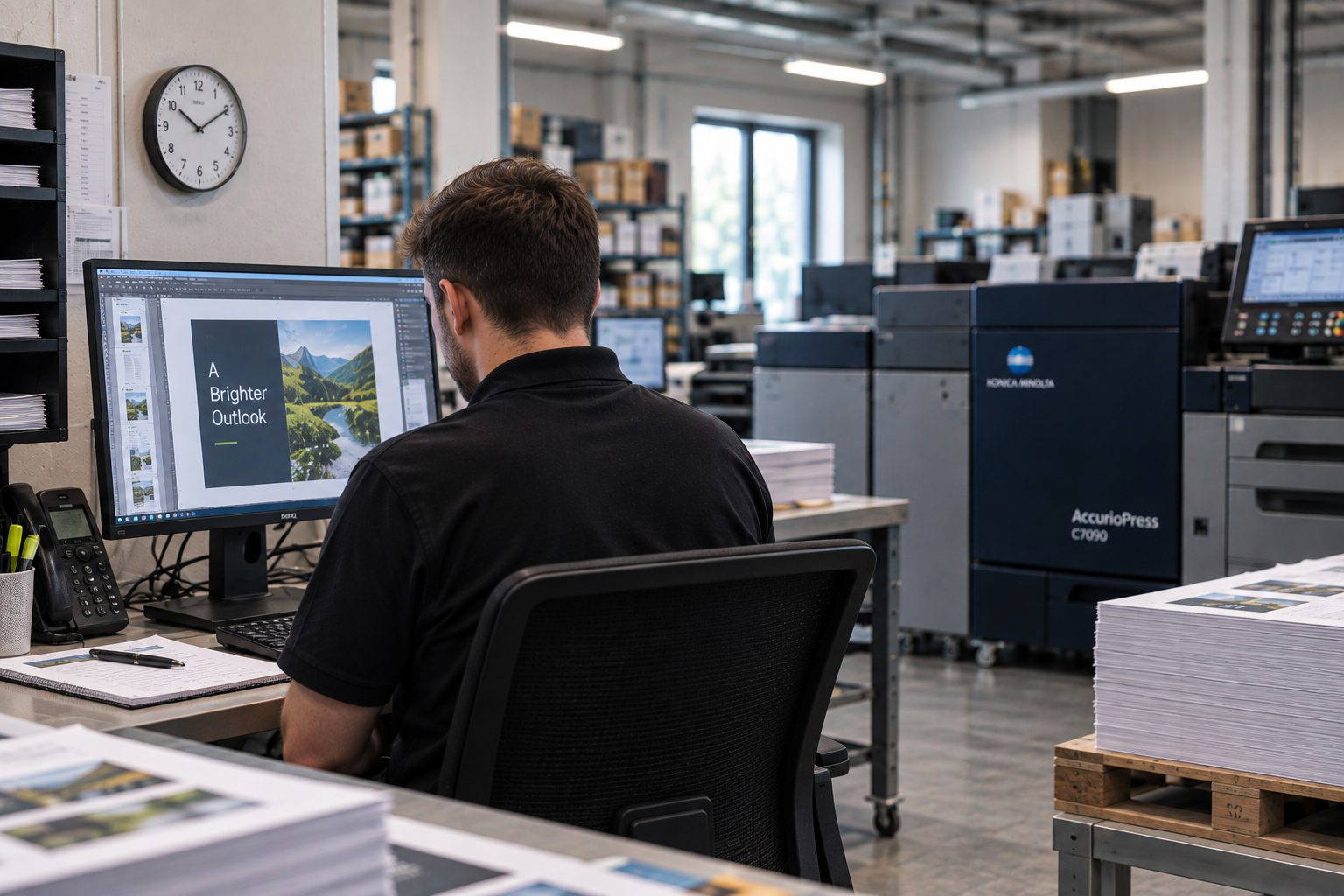
“How long does printing take?” sounds like a simple question, but the honest answer is: it depends what is being printed, how complete the artwork is, and what needs to happen after the sheets come off the press.
For Melbourne Print, turnaround timing begins once usable artwork and the full job specification have been confirmed. That means the size, quantity, paper or board, single or double-sided printing, finishing, delivery method and any proofing requirements are clear. A vague brief, missing bleed, low-resolution images or an undecided paper choice can all add time before production even starts.
What affects printing turnaround time?
A straightforward digital print job can often move quickly, especially when the file is ready, the stock is available and no specialist finishing is needed. Toner-based digital printing is well suited to short runs and urgent work because there is less set-up than some other production methods. Dry toner is fused onto the surface of the paper or board, then the job can move on to trimming, folding or packing.
However, printing turnaround time is not just the time taken to put an image onto paper. The job may need artwork checks, a PDF proof, imposed pages, machine set-up, cutting, creasing, folding, laminating, booklet making, binding, packing and dispatch. Each step needs a realistic amount of time, particularly if accuracy matters.
When does the printing lead time actually start?
Printing lead time should be counted from approval, not from the first enquiry. If you send a file at 4.30pm with missing fonts, no bleed and an uncertain quantity, the clock has not really started. The same applies if a proof is issued and approval does not come back until the following morning.
A typical order moves through these stages:
- Brief, quote and specification confirmed.
- Artwork supplied and checked for obvious production issues.
- Proof supplied if needed, then approved by the customer.
- Printing scheduled around stock, quantity and workload.
- Finishing, trimming, packing and collection or delivery arranged.
Proofing is there to reduce risk. It can catch layout problems, page order issues, unexpected sizing and visible artwork errors. It also adds time, because the job should not proceed until the proof has been checked and approved.
How long does it take to print a poster?
If you are wondering how long does it take to print a poster, the answer depends on the size, material and finishing. A simple A3 or A2 poster from a print-ready PDF is usually one of the quicker jobs, provided the paper is in stock and the file is correctly supplied. Larger posters, heavier materials, mounting, encapsulation or multiple versions can take longer.
The file also matters. A poster supplied at the wrong size, with a low-resolution logo or important text too close to the edge, may need correction before it is safe to print. If you need a poster for an event, allow time not only for printing but also for checking, trimming, collection or courier delivery.
Why urgent simple jobs are different from complex finished jobs
An urgent batch of single-sided flyers on a stock already held in-house is very different from a brochure with folded sections, laminated covers and binding. The first job may have few stages. The second has more chances for delay because it depends on several processes lining up in the right order.
Quantity also changes the picture. Ten presentation copies may be quick to produce, while thousands of sheets need more machine time, more finishing time and more packing. Even on digital equipment, a larger run still has to be printed, checked and handled properly.
Specialist work can add another layer. Items such as unusual binding, die-cutting, foiling, mounting or certain display materials may need outsourced production or extra scheduling. That does not mean the job is difficult, but it does mean the lead time has to include more than in-house print time.
Collection, delivery and avoiding last-minute pressure
Collection is usually the fastest option once a job is complete, because it removes courier schedules from the equation. Delivery needs packing time, booking time and transit time. Next working day services can still be affected by cut-off times, location, weather, traffic and courier capacity.
The best way to keep a job moving is to supply a print-ready PDF, confirm the size and quantity, choose a realistic stock, respond quickly to proof questions and be clear about the true deadline. If a date is fixed, such as an exhibition, meeting or launch, say so at the start. A good turnaround is not just fast printing; it is a planned route from approved artwork to finished print without unnecessary surprises.
Working to a fixed date?
Tell us what you need, when it must be ready and whether your artwork is complete. We can confirm a realistic production plan before you commit. Discuss your deadline with Melbourne Print.