
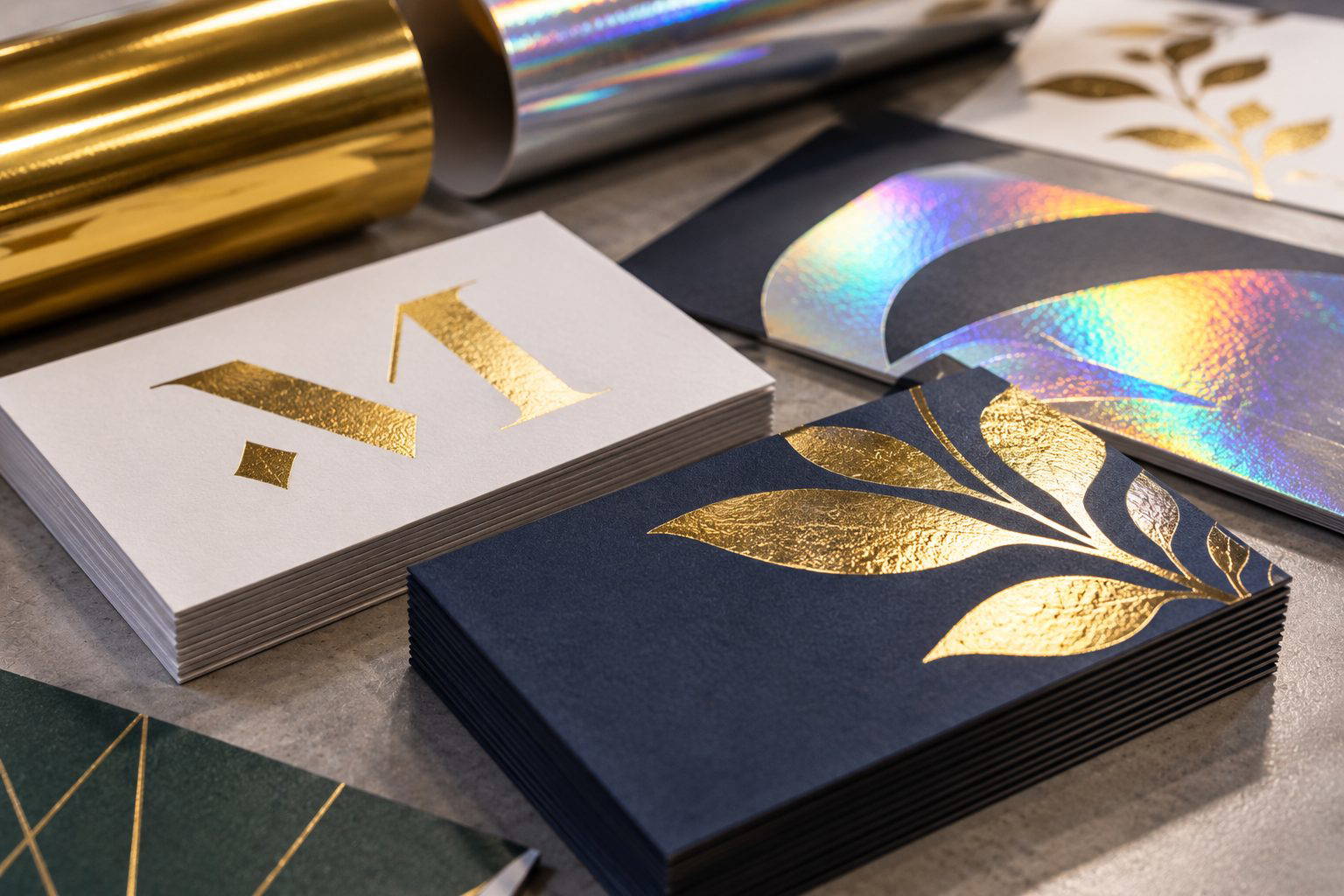
If you want to add metallic foil to a short-run printed piece, toner foiling can be a really useful option. It works particularly well for things like business cards, invitations, packaging, stickers and promotional print where you want a premium finish without moving into a more involved traditional foiling process.
That does not mean every design is automatically suitable, though. The stock, artwork and the way the foil is being applied all make a difference to the finished result.
How toner foiling works
With toner foiling, the metallic foil bonds to areas of toner on the printed sheet. That means the artwork needs to be prepared so the parts you want foiled are created as separate toner areas.
Heat and pressure are then used to transfer the foil onto those areas.
It is a clever process because it gives us much more flexibility for short runs than some traditional foiling methods, but it also means the quality of the toner coverage and the surface underneath it matter.
Simple artwork usually gives the best result
If someone asks us what works best for foil, our first recommendation is normally to keep the foiled elements reasonably bold.
Solid shapes, larger lettering and simple graphic details tend to give a cleaner, more consistent result than extremely fine lines or tiny reversed-out details.
That does not mean the design needs to be basic. It just means you should think about foil as a physical finishing process rather than another ink colour.
If a line is incredibly thin or a detail is very small, there is less area for the foil to bond to and any small inconsistency becomes much more noticeable.
The stock makes a difference too
A smooth surface will normally give us a cleaner foil edge than a heavily textured stock.
That is one of those cases where choosing the most expensive or most unusual paper does not automatically give the best result.
If the foil effect is the main feature of the design, we would usually rather start with a stock or laminated surface that gives the foil a good, consistent base.
There can still be situations where a textured or uncoated material works well, but we would look at the whole design before recommending it.
Lamination can be part of the process
On some jobs, particularly where there is already a lot of printed toner on the sheet, we may laminate the printed piece before applying the foil.
This gives us a cleaner surface to work with and can also create a really nice contrast between the laminate and the metallic detail.
Matt lamination with metallic foil is a good example. The flatter matt surface helps the reflective foil stand out much more strongly.
It is not something we would automatically add to every job, though. The right production route depends on the stock, the amount of toner, the finish you are trying to achieve and what the finished piece actually needs to do.
Where toner foiling works particularly well
We tend to like toner foiling for short-run pieces where a small detail needs to do a lot of the visual work.
That might be:
- a metallic logo on a business card;
- a foil name or detail on an invitation;
- a premium accent on short-run packaging;
- a small area of metallic detail on a sticker;
- or a simple graphic element on a promotional piece.
You do not necessarily need to cover half the design in foil for it to feel premium. Quite often a smaller, well-placed foiled detail looks better than trying to make everything metallic.
When we would suggest another approach
Toner foiling is not the answer to every foiled print job.
If the run is much larger, the design is extremely detailed, the substrate is unusual or the finish needs to behave in a very specific way, another production method may be more suitable.
That does not mean the job cannot be produced. We can look at the specification and, where necessary, use one of our selected specialist suppliers if a different foiling method will give a better result.
We would rather recommend the right production route than force a design through a process that does not suit it.
What we’d recommend
If you are designing something specifically for toner foiling, keep the important foil details reasonably bold, think about how the stock or laminate will affect the finish, and let us see the artwork before everything is completely locked down.
That gives us a chance to spot anything that might cause a problem and suggest a better way of setting it up if needed.
Thinking about adding foil to your print?
Send us the artwork or tell us what you are planning to produce and we can recommend the most suitable way to achieve the finish. Talk through your project.